
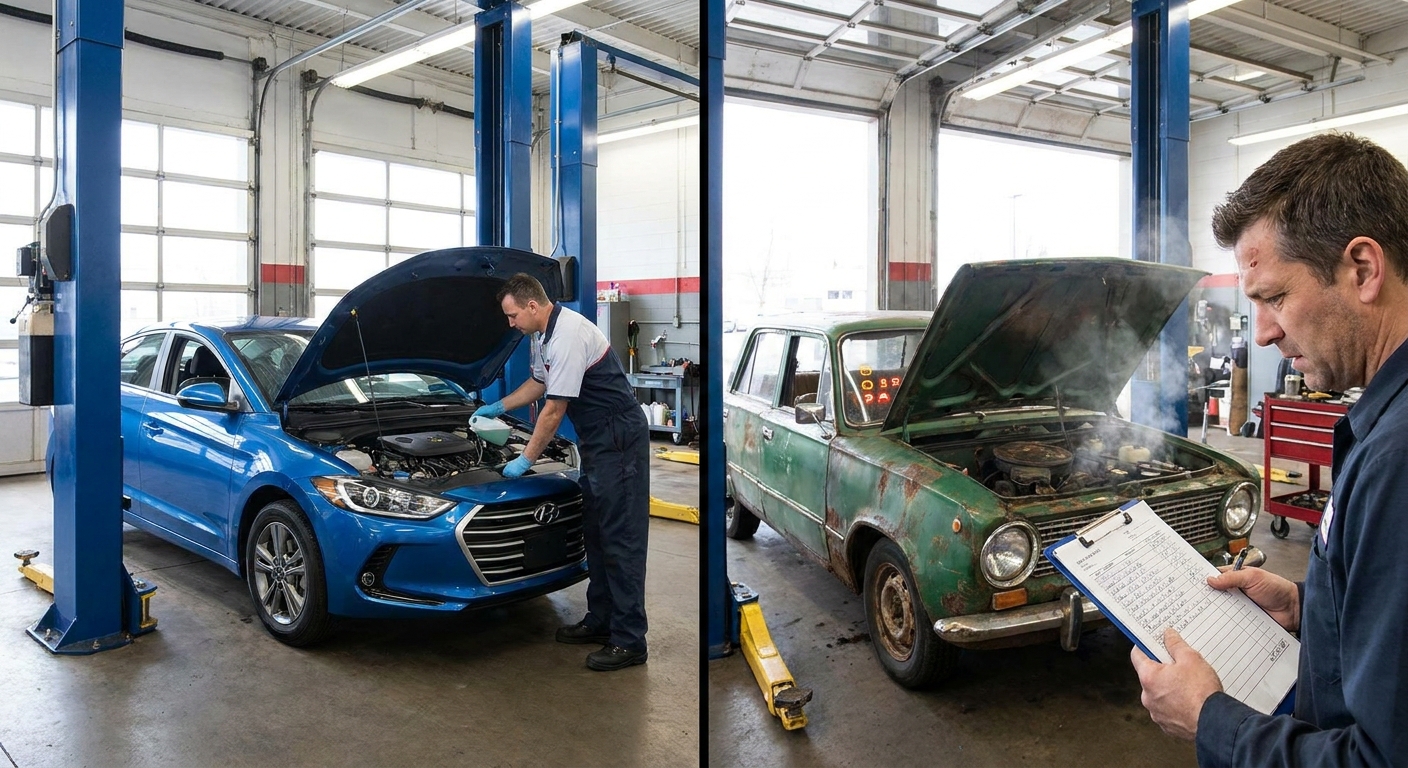
Ask ten drivers about car maintenance and you’ll hear two camps:
Introduction
- “I change everything on time. It’s cheaper in the long run.”
- “I just fix it when it breaks. Why waste money early?”
Both sides think they’re saving money. One is mostly right.
This article looks at preventive vs. reactive car care in everyday, real‑world terms, not theory. We’ll walk through five major areas—oil, cooling, brakes, tires, and the battery/charging system—and compare what planned maintenance actually costs versus what happens when you wait until something fails.
The goal is simple: help you decide where preventive care truly pays off, and where you can safely stretch things a little.
1. Engine Oil: The Cheapest Insurance You Can Buy
Engine oil is one of the few areas where cutting corners almost never makes sense.
Preventive Approach
- Change oil and filter on time—using the interval in your owner’s manual or slightly sooner if you drive in heavy traffic, short trips, or extreme temperatures.
- Typical cost:
- DIY: $30–$60 per change (quality oil + filter)
- Shop: $60–$120 depending on vehicle and oil type
Over 100,000 km, you might do 10–15 changes. That’s in the ballpark of $600–$1,500 total.
Reactive Approach
“Oil is oil. I’ll change it when the light comes on or when I remember.”
Risks include:
- Sludge buildup, which can clog tiny oil passages
- Accelerated wear on timing chains, camshafts, and bearings
- Increased oil consumption and blow‑by
Real‑world outcomes:
- Best case: Shortens engine life significantly; you sell the car before the bill shows up.
- Typical case: Timing chain or variable valve timing system issues—often $1,000–$3,000 to repair.
- Worst case: Engine failure. Replacement or rebuild usually costs $4,000–$10,000+, often more than the value of an older car.
Verdict
Oil changes are the textbook example where preventive wins big. Skipping a $100 service can easily lead to a $5,000 problem—usually with very little warning.
2. Cooling System: Overheating vs. Simple Coolant Service
Modern aluminum engines hate heat. A single, aggressive overheat can ruin an otherwise healthy powertrain.
Preventive Approach
- Replace coolant every 3–5 years or per manufacturer spec.
- Inspect hoses, belts, and the radiator periodically.
- Catch minor leaks (like small hose seepage or a weak radiator cap) early.
Typical costs:
- Coolant flush: $120–$250
- New radiator hose: $50–$150 installed
- Thermostat replacement: $150–$350
Spread over several years, these are manageable, planned expenses.
Reactive Approach
“I’ll deal with it when I see the temp gauge spike.”
By the time the gauge spikes, damage may already be happening:
- Warped cylinder head from overheating
- Blown head gasket
- Cracked head or block in severe cases
Real‑world outcomes:
- Head gasket job: $1,500–$3,000+ depending on vehicle
- Engine replacement: $4,000–$10,000+
- Stranded at the worst possible time (vacation, late for work, stuck on shoulder)
Anecdotally, many mechanics will tell you: cooling-system neglect kills more engines than high mileage does.
Verdict
Preventive cooling-system care—fresh coolant, solid hoses, healthy radiator—is boring and invisible when it’s working. But compared to the cost of even one major overheat, it’s absolutely worth it.
3. Brakes: Wear Items vs. Collateral Damage
Brakes are consumable parts. They’re supposed to wear out. The question is how much extra damage you allow while they’re doing their job.
Preventive Approach
- Inspect pads and rotors at least annually or when tires are rotated.
- Replace pads before they hit metal; resurface or replace rotors when needed.
Typical costs:
- Pads + rotors (per axle): $250–$600 depending on car and parts quality
- Brake fluid flush (every ~2–3 years): $80–$160
You decide when to book the appointment; you choose your parts.
Reactive Approach
“It still stops, so the brakes are fine.”
Ignoring squeals, vibrations, or grinding often leads to:
- Pads wearing to metal and chewing into rotors
- Caliper damage if pistons overextend or seize
- Overheated, glazed, or cracked components
Real‑world outcomes:
- Metal‑on‑metal brakes: Pads + rotors + possibly calipers
- Bill can easily double: $500–$1,200+ for what started as a basic job.
- Safety risk: Longer stopping distances, pull to one side, or even brake failure in extreme cases.
Verdict
Here preventive care is less about saving thousands and more about avoiding doubled repair bills and safety scares. Replacing brakes early is rarely money wasted.
4. Tires and Alignment: Grip vs. False Economy
Tires are another consumable, but unlike brakes, you feel them every minute you’re moving. Grip, noise, comfort, and fuel economy are all tied to tire condition.
Preventive Approach
- Keep tires at proper pressure (check monthly).
- Rotate every 8,000–10,000 km or as advised.
- Get alignment checked when you notice pull, uneven wear, or after suspension work.
Typical costs:
- Set of decent tires: $400–$1,000+ depending on size and brand
- Rotation: Often free with purchase, or $30–$60
- Alignment: $80–$150
With good habits, your tires last longer and wear evenly.
Reactive Approach
“I’ll just drive them until they’re bald on the edges.”
Consequences:
- Uneven wear from bad alignment shortens tire life dramatically.
- Poor wet‑weather grip leads to longer stops and easy hydroplaning.
- Minor vibration or pull turns into chronic steering and suspension stress.
Real‑world outcomes:
- Replacing a set of prematurely worn tires can cost hundreds of dollars sooner than necessary.
- Ignoring alignment can help wear out suspension parts, adding another $300–$800+ down the line.
Verdict
Tires and alignment are where many drivers “save” money in the short term and lose it quietly over time. Proper alignment and rotation are classic examples of small preventive expenses that extend the life of a big-ticket item.
5. Battery and Charging System: Inconvenience vs. Planned Replacement
Here’s one area where the financial difference between preventive and reactive is smaller, but the stress difference is huge.
Preventive Approach
- Replace the battery around the 4–5 year mark, depending on climate.
- Have the charging system (alternator) tested if you notice dim lights, slow cranking, or electrical oddities.
Typical costs:
- Quality battery: $120–$250
- Alternator replacement: $400–$900 depending on vehicle
You choose the timing—maybe before winter or before a big trip.
Reactive Approach
“I’ll keep it until it dies.”
What usually happens:
- The car won’t start—in a grocery store lot, at the airport, or at 6 a.m. before work.
- You pay for an emergency jump or a battery at whatever shop is open.
Real‑world outcomes:
- Battery + emergency service can cost 50–100% more than a planned replacement.
- If low voltage goes on too long, the alternator works overtime trying to keep up, shortening its life.
Verdict
You can run a battery to the end, but understand the tradeoff: not huge savings, just exchanging predictable cost for random inconvenience. A reasonable middle ground is to start testing more often after year three and replace at the first sign of weakness.
Putting It All Together: A Practical Strategy
Based on what tends to fail and what it costs when it does, here’s a prioritized view:
1. Non‑negotiable Preventive Maintenance
Focus here first—problems are expensive or dangerous:
- Engine oil and filter on schedule
- Cooling system (coolant, hoses, early leak repairs)
- Brake pads/rotors and brake fluid
2. High-Value Preventive Maintenance
Strong ROI in cost, comfort, and safety:
- Tires: proper pressure, rotation, timely replacement
- Alignment checks when symptoms appear
- Transmission fluid at recommended intervals (especially automatics)
3. Flexible Preventive Maintenance
You can tune the schedule based on your risk tolerance:
- Battery replacement timing (test regularly after year three)
- Spark plugs and filters (don’t wildly exceed intervals, but a small delay isn’t catastrophic)
Conclusion
Preventive car care isn’t about doing everything early and spending money for fun. It’s about spending a little on your terms to avoid paying a lot on your car’s terms.
If your budget is tight, start with the heavy hitters—oil, cooling system, and brakes—then move toward tires and alignment. Once those are under control, the smaller items fall into place.
In the long run, the “fix it when it breaks” strategy almost always turns out more expensive. The only question is whether the extra cost shows up as cash, stress, or both.