
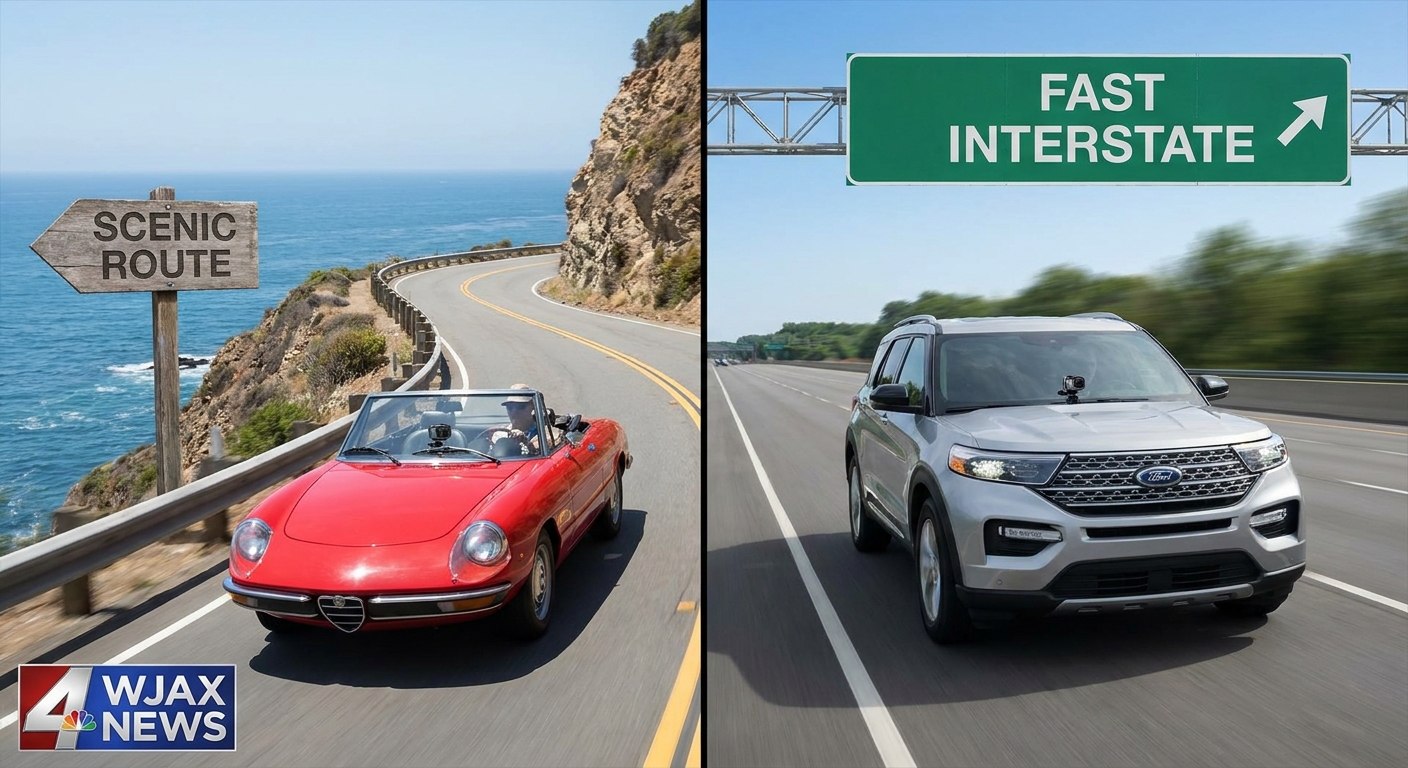
Ask three drivers to plan a road trip and you’ll get three different philosophies:
Why Your Road Trip Style Matters More Than Your Destination
- One wants the fastest route: highways, cruise control, and the fewest stops.
- Another wants the scenic option: back roads, viewpoints, and quirky small towns.
- The third wants a balanced drive: decent pace, but some memorable detours.
None of these are wrong—but each one asks something different from you, your passengers, and your car. Picking the wrong style for your situation is how you end up grumpy, behind schedule, or nursing a tired engine up a mountain pass.
Here are five clear comparisons to help you choose (or blend) the right road trip style for your next drive, with practical advice tailored to both everyday drivers and enthusiasts.
1. Route Choice: Big Highways vs. Back Roads
Fast-Route Focus (Highways & Interstates)
- Best for: Time-sensitive trips, newer cars, steady drivers.
- Pros:
- Predictable surfaces and services (fuel, food, rest areas).
- Easier navigation and usually more consistent cell coverage.
- Less gear-shifting fatigue if you drive manual.
- Watch out for:
- Monotony leading to drowsiness.
- Higher, constant speeds stressing weak cooling or worn tires.
Scenic-Route Focus (State Routes, Rural Roads, Mountain Passes)
- Best for: Flexible schedules, drivers who enjoy the act of driving.
- Pros:
- Varied scenery and more engaging roads.
- Lower average speeds reduce strain on older vehicles.
- Often less traffic and more interesting stops.
- Watch out for:
- Fewer fuel stations; you can’t run the tank low.
- Narrow shoulders and limited passing opportunities.
- Rough patches that expose weak suspension or cheap tires.
Practical tip:
Even if you’re time-focused, consider making one day of your trip a scenic leg. Conversely, if you’re scenic-obsessed, use a highway-heavy day at the start or end when you’re freshest or most eager to get home.
2. Time vs. Energy: How Far Should You Really Drive in a Day?
The distance you can reasonably cover depends less on your endurance fantasy and more on your real daily energy budget and your car’s comfort level.
Fast-Route Expectations
- On mostly highway driving, 500–650 miles a day is common—but it’s work.
- You’ll spend long uninterrupted stretches in the seat, which punishes weak lumbar support and poor seating position.
Scenic-Route Expectations
- On secondary roads, 250–400 miles can feel full but satisfying.
- Speeds vary more; the drive demands more attention but provides more mental stimulation.
How to pick your number:
- For families with kids or pets, aim low: 250–350 miles, regardless of route.
- For solo drivers in well-set-up cars, 400–550 highway miles is realistic if you build in real breaks.
- For older vehicles or those with mods that make them louder/stiffer, favor the lower end of those ranges.
Practical tip:
Plan your first day to be shorter than your longest. Use it as a shakedown: if you arrive tired after 300 miles, 600 was never going to be pleasant.
3. What Your Car Is Actually Built For (and How to Use That)
Your car’s design quietly favors one road trip style over another. Tap into that instead of fighting it.
Comfort-Oriented Sedans, Crossovers, and Minivans
- Strengths:
- Stable and quiet at highway speeds.
- Seats and suspensions tuned for long stints.
- Sweet spot: Fast-route or balanced trips where you can sit at a steady speed for long periods.
Compact Cars and Older Daily Drivers
- Strengths:
- Easy to place on narrow roads, more fun at lower speeds.
- Cheaper to run; great for budget scenic routes.
- Sweet spot: Scenic or moderate-distance days where you’re not asking them to hold 80 mph all day.
Performance Cars and Enthusiast Builds
- Strengths:
- Precise handling, rewarding on twisty back roads.
- Strong power for passes and mountain climbs.
- Sweet spot: Thoughtfully chosen scenic routes with good pavement and flowing curves.
Trucks and SUVs, Especially When Loaded or Towing
- Strengths:
- Room for gear, capable on poor surfaces, more tolerant of unpaved detours.
- Sweet spot: Mixed routes where some gravel or forest roads are on the menu—but watch speeds on loose surfaces.
Practical tip:
If your car is old, lowered, or heavily loaded, avoid long stretches of broken pavement and poorly maintained shortcuts the map app suggests. In those situations, the “fast” highway may also be the kindest to your vehicle.
4. Budget and Fuel: Scenic Isn’t Always Cheaper—or More Expensive
Many drivers assume highways burn more fuel because speeds are higher or that scenic routes are always cheaper because speeds are lower. The reality depends on your engine and gearing.
Highway-style driving:
- Modern cars often achieve their best fuel economy at steady speeds in the 55–70 mph range.
- Past a certain speed, wind resistance takes a toll; that “extra 5–10 mph” can noticeably hurt mileage.
Back-road style driving:
- Lower speeds reduce aerodynamic drag but introduce more speed changes and lower gears, which can cancel out the gains.
- Tight, hilly routes can be surprisingly thirsty, especially for performance engines.
Where the money really goes:
- Scenic routes often mean more stops for snacks, attractions, and small-town restaurants.
- Fast routes sometimes lead you to expensive fuel near major interchanges.
Practical budgeting advice:
- Use your car’s real-world average fuel consumption, not the brochure number. Multiply by planned distance and round up.
- On scenic-heavy trips, add a small daily buffer for “we found a great spot” expenses.
- Apps that track fuel prices can help you plan where to fill up—often just 10–15 miles off a big-city center can save money.
In short, choose route style for your enjoyment and your car’s comfort first; tweak speed and stop choices to manage the budget.
5. Safety, Stress, and the Human Factor
Different road trip styles pose different safety and stress profiles.
Fast-Route Safety Profile
- Risks:
- Higher-speed incidents are more severe.
- Drowsy driving is more common on long, straight interstates.
- How to manage:
- Use a strict rotation if you have multiple drivers—change every 2–3 hours, not “whenever someone feels like it.”
- Build in mandatory leg-stretch stops; don’t rely only on fuel stops.
Scenic-Route Safety Profile
- Risks:
- Wildlife, blind corners, sudden stops from locals turning into driveways.
- Temptation to drive “just a bit faster” on fun, flowing roads.
- How to manage:
- Respect local speed limits; they usually reflect real hazards you can’t see yet.
- Increase your following distance; curves hide what’s ahead.
Mental Load and Group Dynamics
- Fast routes can lead to boredom and irritability if passengers feel trapped.
- Scenic routes can cause schedule anxiety if someone in the group is fixated on arrival time.
Practical alignment check:
Before you leave, ask your fellow travelers:
- “Is this trip more about getting there or what we see on the way?”
- “How many hours a day are you comfortable being in the car?”
Use those answers to bias your plan:
- More “getting there” answers → favor highway legs, but schedule one or two scenic detours.
- More “what we see” answers → reduce daily mileage and lean into scenic segments.
Blending Styles: The Best of Both Worlds
You don’t have to commit 100% to scenic or fast. Many of the best road trips mix both intentionally:
- Use fast routes to clear dull or traffic-heavy regions.
- Switch to scenic roads in the last 2–3 hours of the day when golden-hour light makes everything better.
- Let your car type and passenger tolerance decide which days are long, straight pushes and which are shorter, twistier explorations.
If you choose a style that suits your car and your people—and you’re honest about how many hours you can happily drive—you’ll spend more time appreciating the road and less time fighting it.
In the end, the “right” road trip style is the one you can finish wanting to drive again tomorrow, not the one that looks best on a map.